





 5671
/ 9 MIN READ
5671
/ 9 MIN READ
 Follow Us
4,600+ | 80% | ₹15,000 Cr+ | 30% CAGR |
|---|
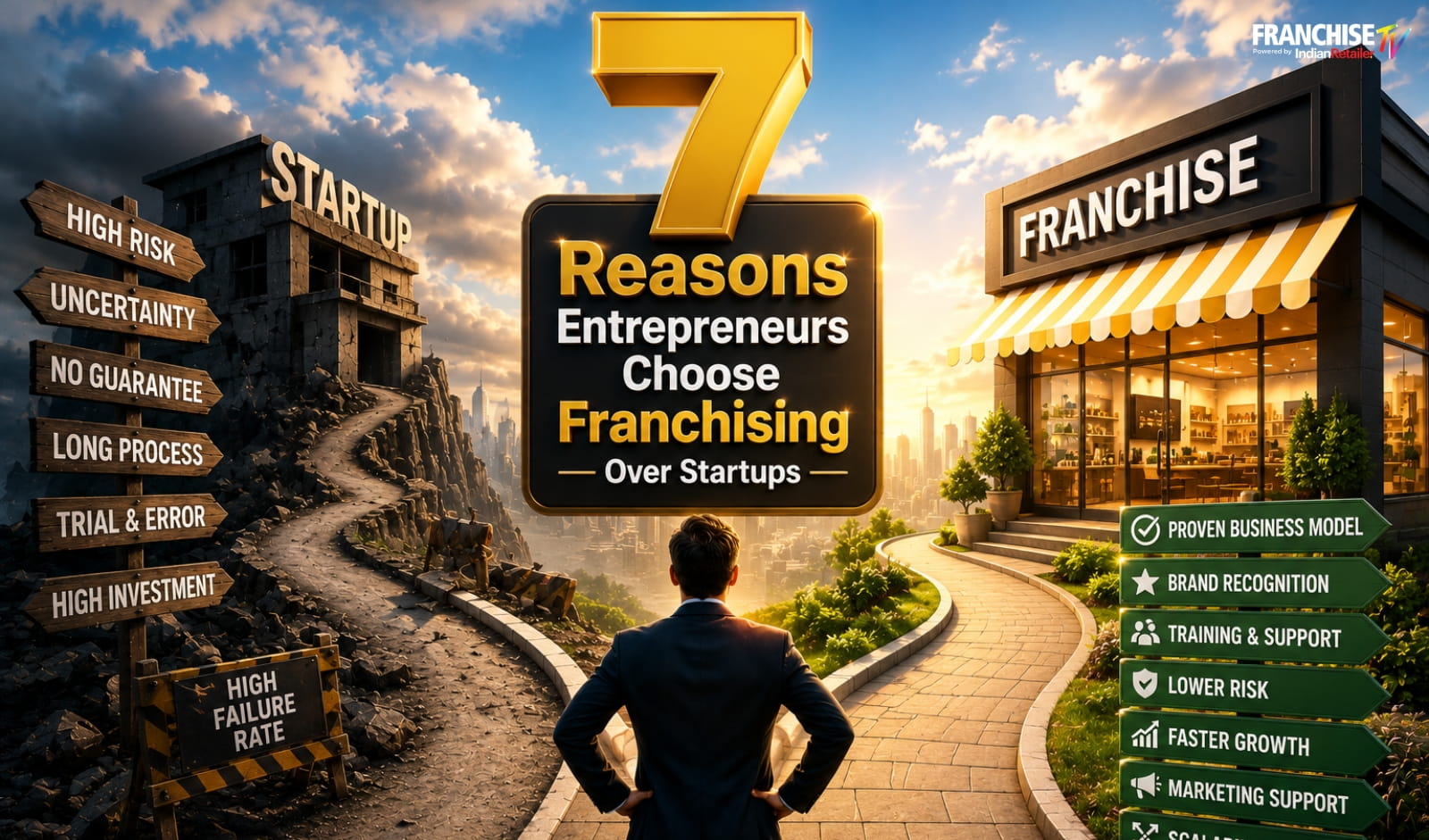
Every week, thousands of Indians quit their jobs with one dream — to build something of their own. Most reach the same fork in the road: start from scratch or buy into a proven system? In 2026, a growing majority are quietly choosing franchising. Here is the real, unfiltered reason why.
Startup culture gets all the attention. The pitch decks, the funding rounds, the TED Talk moments. But behind that glamour sits a number nobody puts on a poster — 90% of Indian startups fail before their fifth year. Meanwhile, franchise businesses in India are quietly generating stable income, creating jobs, and building generational wealth for ordinary people. This is not luck. It is structure.
1. You Buy Proof, Not a Promise
Every startup begins with a hypothesis. A franchise begins with a verdict. When you invest in a franchise business in India, the product has been tested, the pricing refined, the customer service model proven — across real locations, with real money, long before yours enters the picture. You are not guessing. You are executing.
✦ Insight: Franchisees skip 2–3 years of costly trial-and-error that sinks most startups
2. Brand Trust Is Built In — From Day One
A startup spends its first three years begging for attention. A franchise walks in with it. Customers trust what they recognise — and that trust translates directly to footfall, faster conversions, and lower customer acquisition cost. In Tier 2 and Tier 3 cities especially, a known brand name cuts through market noise that would take an independent business years to overcome.
✦ Insight: Brand recognition reduces marketing spend by up to 40% compared to independent startups
3. The Break-Even Timeline Is Radically Shorter
Cash flow is the number one killer of new businesses. The best franchise opportunities in India 2026 — in healthcare, education, laundry, QSR, and EV services — are breaking even in 12 to 18 months on average. Most independent startups, if they survive at all, are still unprofitable at the three-year mark. Time is money, and franchising saves both.
✦ Insight: Avg. franchise break-even in India: 12–18 months vs 36–60 months for startups
4. Low Investment, High-Support Entry Points Exist
The myth that franchising requires massive capital stops many from exploring it. In reality, a low investment franchise in India can begin from as little as ₹2–5 lakhs — covering diagnostic collection points, tutoring centres, courier franchises, and home service kiosks. The capital barrier is far lower than building and marketing a startup product from zero.
✦ Insight: 60% of franchise formats in India are available under ₹15 lakhs total investment
5. Training and Ongoing Support Replace Guesswork
When a startup founder hits a wall — operationally, financially, strategically — they google it or call a consultant. A franchisee calls their franchisor. Full onboarding, operations manuals, supply chain access, technology platforms, and a dedicated support team are built into the model. This is the infrastructure that makes a profitable franchise business India owners run with confidence even in their first month.
✦ Insight: 78% of franchisees cite ongoing support as the #1 reason they chose franchising
6. Scaling Is Simpler — and Built Into the System
One successful location becomes two. Two become five. The franchise model is architecturally designed for replication. Every process, every standard, every supply chain is already documented. Expanding a franchise business in India to a second city does not require reinventing anything — it requires capital and execution. Startups have to rebuild their systems every time they scale.
✦ Insight: Multi-unit franchise operators in India grew by 34% year-on-year in 2025–26
7. India's Economy Is Actively Rewarding This Model in 2026
India's consumption story — rising middle class, Tier 2 city expansion, digital-first lifestyles — is perfectly aligned with the franchise expansion model. Sectors like EV services, premium wellness, education, and organised retail are growing at 25–35% annually, and franchising is the fastest route to capture that demand. Smart entrepreneurs are not just choosing franchising for safety — they are choosing it because the timing has never been better.
✦ Insight: India's franchise industry crossed ₹15,000 Cr in 2026 with 30%+ annual growth
Read more: Why Modern Jewelry Brands Are Betting Big on Franchising
ASV Polkis Expands Through FOCO Model to Capture India’s Luxury Jewellery Opportunity
Top 6 Dessert & Sweet Franchise Brands Expanding Fast in India
The Honest Truth No One Tells You
Franchising is not for people who want to reinvent the wheel. It is for people who want to drive a proven vehicle — faster, farther, and with far less risk of breaking down. If your goal is creative disruption and you have the capital and tolerance to absorb years of losses, a startup may be your path. But if your goal is building a profitable, scalable business in India in the next 12–24 months, franchising is not the safe option — it is the smart one.
FREQUENTLY ASKED QUESTIONS
Franchising offers a proven business model, built-in brand recognition, operational support, and faster break-even — significantly reducing the risk that causes 90% of Indian startups to fail within five years.
Healthcare diagnostics, tutoring centres, courier franchises, and home service kiosks are among the best low investment franchise options in India, starting from ₹2–5 lakhs with strong ROI.
In most cases, yes. Profitable franchise businesses in India reach break-even in 12–18 months and carry an 80%+ success rate, compared to a 10–20% success rate for independent startups over five years.
EV services, healthcare and diagnostics, education and upskilling, premium laundry, and quick service restaurants are the fastest-growing and most profitable franchise sectors in India right now.
For Further Franchise Info Contact

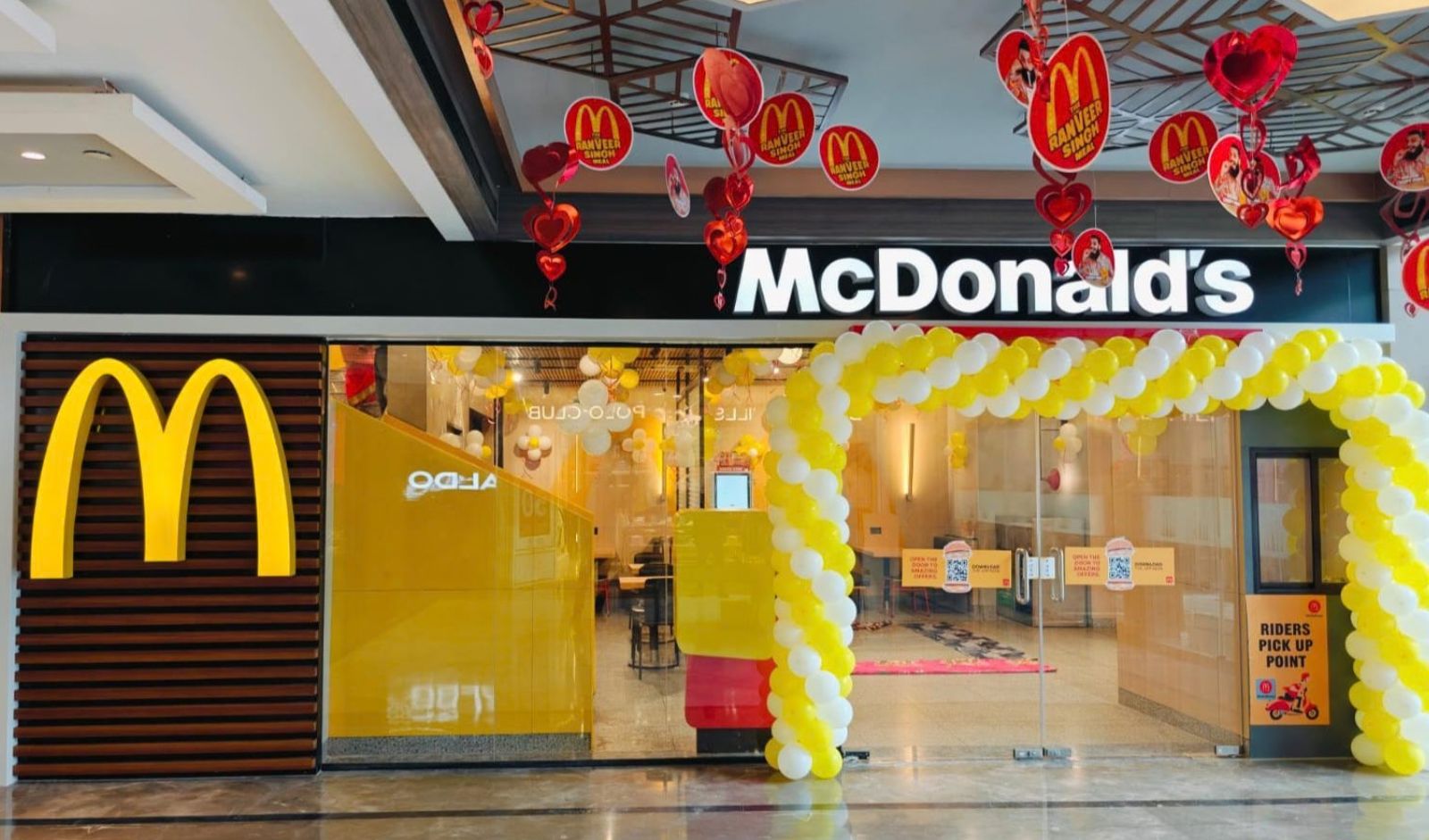
McDonald's Corporation details its ‘McDonald’s NEXT’ strategy and announces new financial targets tied to the enhanced growth and productivity that this new strategy will enable.
McDonald’s NEXT is leveraging the capabilities built through accelerating the Arches - with dedicated value leadership to create more demand and deliver it more efficiently to drive growth.
Commenting on the new development, Chris Kempczinski, McDonald’s Chairman and Chief Executive Officer, shares: “McDonald’s has the unmatched scale, customer insights, brand loyalty, and operational capabilities to not only adapt to the next wave of change in our industry, but to turn it into an advantage.” He adds, “McDonald’s NEXT is about: to be the first choice for more customers, more often - while making our restaurants stronger and easier to run. We are confident that executing across the key components of NEXT will unlock stronger restaurant economics, generate attractive returns for the company, our franchisees and shareholders, and increase capacity to keep investing in growth.”
Since the launch of the Accelerating the Arches strategy in 2020, the Company has continued to successfully modernize its technology and infrastructure to better leverage its operational advantages and scale. This includes building common technology platforms, a single enterprise data foundation, and operating systems and capabilities across more than 46,000 restaurants, helping to identify opportunities faster, test them rigorously, and deploy what works more efficiently.
The 4 Pillars of NEXT Strategy
As customer expectations and industry dynamics continue to shift, McDonald’s NEXT will ensure the company is positioned to drive durable comparable sales and guest count growth, gain market share, and enhance restaurant productivity. The four pillars of McDonald’s NEXT are: menu, restaurant, consumer and people.
The brand aims to elevate taste and quality through gold standard execution and innovation to drive stronger preference, more first-choice occasions, and baseline guest-count growth.
The strategy will then capitalize on McDonald’s brand fandom and further personalizes customer relationships to generate more visits over time.
It further catalyzes growth and fuels productivity through elevated execution, simplifying operations, modernizing restaurant design, and deploying GenAI enabled ArchIQ at scale to unlock about 250 basis points of gross restaurant-level efficiency as McDonald’s NEXT elements are deployed across the U.S. and International Operated Markets.
And finally, it will equip employees to deliver a new level of hospitality that creates a better, more consistent experience for customers – increasing repeat visits.
Investing Alongside Franchisees
To accelerate restaurant modernization, technology deployment and operational improvements, McDonald's plans to provide approximately USD 8.5 billion in total NEXT partnering support through 2036, including approximately USD 5 billion through 2030, through a combination of rent relief and capital support.
The target of approximately 250 basis points of gross restaurant-level efficiency McDonald's estimates these investments will generate an approximately four-year payback for franchisees, after partnering, while improving both customer and crew experiences.
Financial Performance Expectations
McDonald’s scale and financial strength reflects decades of disciplined execution, prudent decision-making, and a proven ability to create long-term value. McDonald’s NEXT builds on that foundation while allocating capital to drive growth and productivity.
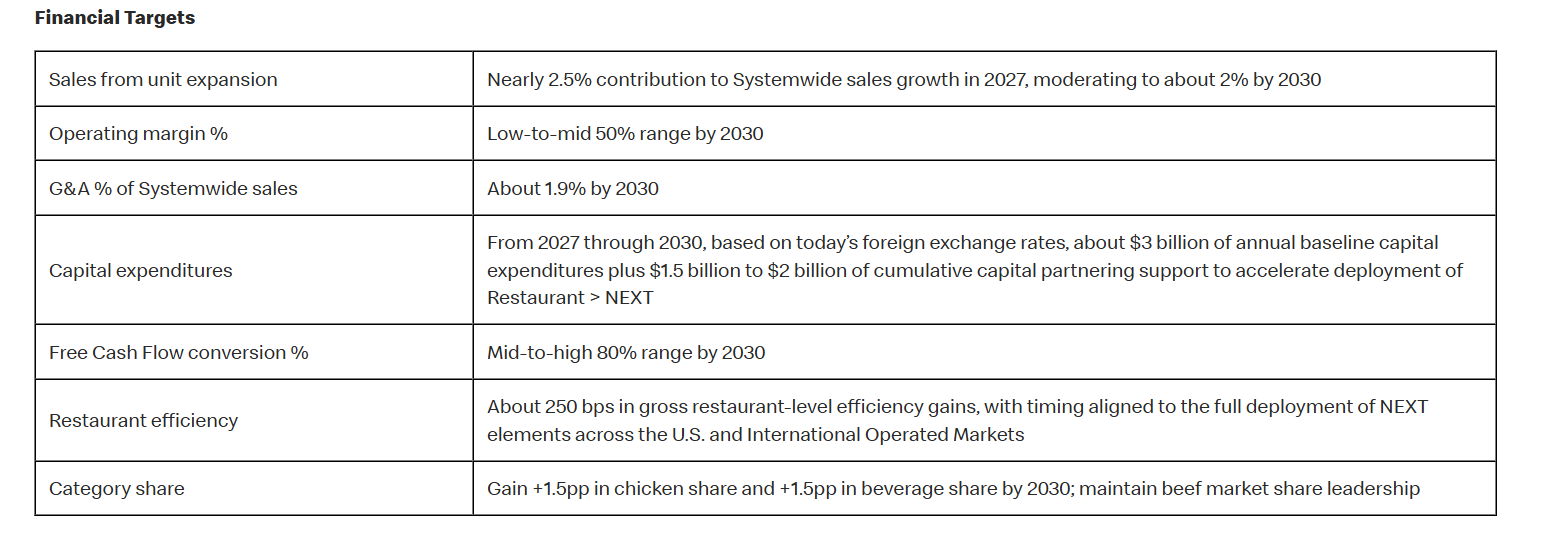
The brand’s financial targets are:
Nearly 2.5% contribution to systemwide sales growth in 2027, moderating to about 2% by 2030
Low-to-mid 50% operating margin range by 2030
USD 3 billion of annual baseline capital expenditures plus USD 1.5 billion to USD 2 billion of cumulative capital partnering support to accelerate deployment of Restaurants.
Mid-to-high 80% free cashflow range by 2030
About 250 bps in gross restaurant-level efficiency gains
This article contains certain forward-looking statements, which reflect management's expectations regarding future events and operating performance and speak only as of the date hereof.
Source: Mc Donald's
For Further Franchise Info Contact
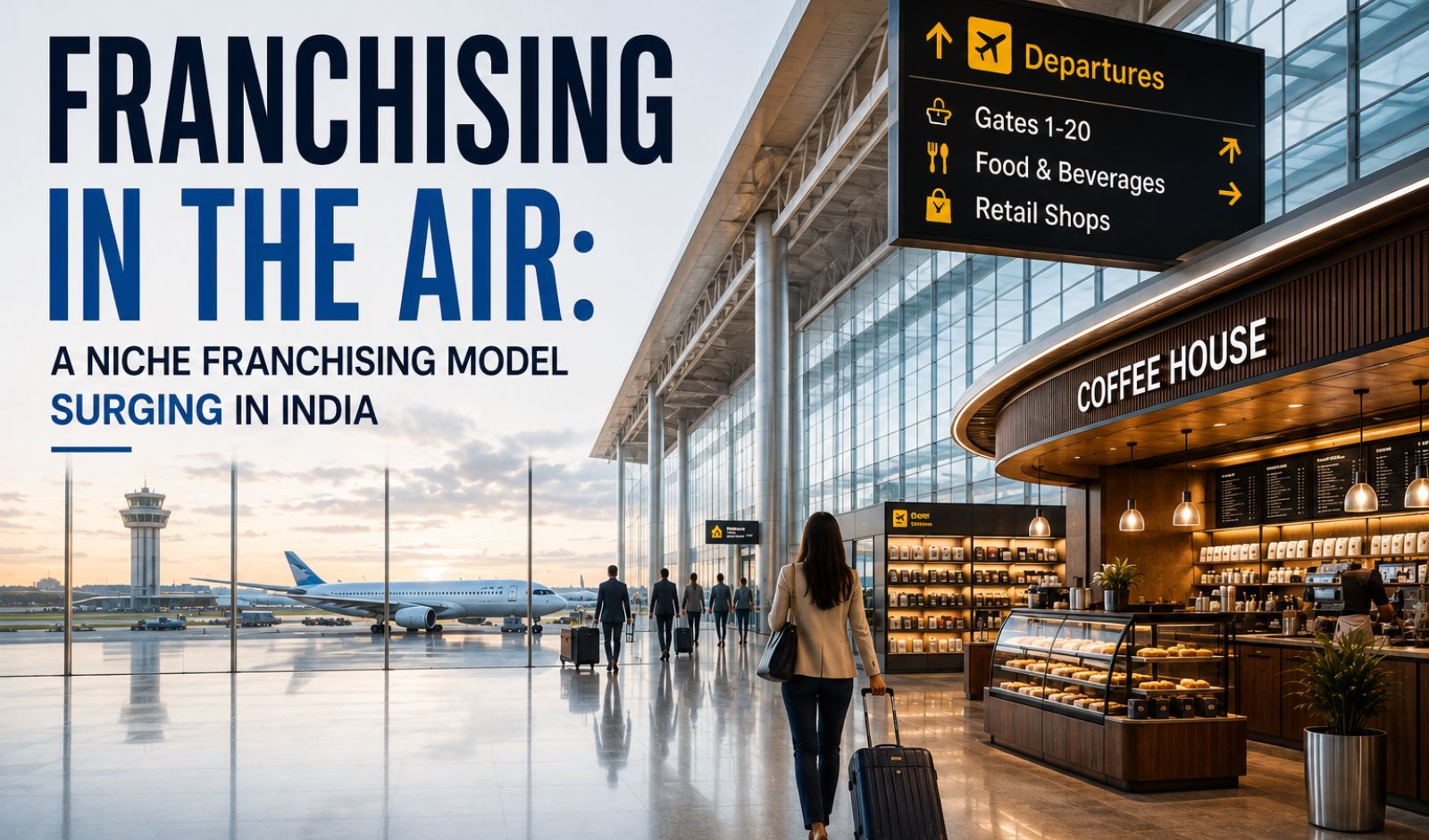
Airport franchising is a highly specialized commercial sector where franchise retail brands secure spaces inside terminals to target a captive, high-volume passenger audience. It covers a major revenue of non-aviation airport revenues, and emerges as a specialized segment in the business franchising model.
Commercial Model for Franchising On Airports
In this niche franchising model, a prime operator secures a master lease for multiple terminal spaces. They then partner with national or global brands via licensing or franchise agreements to run those spaces. The master concessionaire model is when the company that holds the lease agreement for multiple units, actively operates some or all of the concession venues it has.
It works in two formats: Direct Leasing or Third-party Leasing. In direct leasing, the airport authority leases individual spaces directly to specific franchise brands or experienced local franchisees via competitive bidding. On the other hand, in the developer model, a third-party developer leases large commercial sections of the terminal. They act similarly to a shopping mall manager, subleasing individual units out to independent franchise brands.
What Differentiates It from Traditional Franchising?
Franchising at airport terminals is intensely competitive and rarely involves open market negotiation. Locations are typically awarded through a public bidding process known as a Request for Proposal (RFP). There is also a strict evaluation in terms of concepts, financial projections, corporate qualifications, and structural design visions. Moreover, franchising agreements are usually long-term, commonly ranging from 7 to 10 years at large-hub airports due to the massive capital requirements needed to build out a terminal location.
Further, it requires a high-upfront investment rather than small or midsize investments, therefore many franchise companies lose even before the bidding concept starts.
4 Master Brands Involved in This Franchising Model
The key market leaders driving this model include:
1.Travel Food Services (TFS)
Travel Food Services (TFS) is India’s leading food, beverage (F&B), and lounge operator in the aviation and travel infrastructure segment. Operating primarily through a concession-led master franchising and joint-venture model, the company enhances airport spaces with diverse cuisines and innovative dining concepts. Specializing in bringing international brands to airport environments, TFS offers a portfolio that includes renowned names like Copper Chimney and Bombay Brasserie, and has introduced global icons such as Jamie Oliver’s restaurants and Brioche Dorée to India's airport spaces for the first time. Apart from its franchise-led operations, the company also deals in airport lounges, aiming to improve the travel experience through unique lounge environments. Its lounges provide diverse, high-quality and refined luxury experiences as compared to traditional lounge setting, focusing on customer comfort and introducing experiential culinary concepts. The brand has won many accolades including ‘Asia’s Leading Airport Lounge’ and ‘World’s Leading Airport Lounge’ from 2015-2023, ‘FAB Dining Transformation Award’, ‘F&B Marketing & Promotions Campaign of the Year’ and ‘FAB Airport Lounge of the Year.’
2. Devyani International Limited
Devyani International Limited (DIL), a flagship entity of the RJ Corp conglomerate, is India’s franchising master brand of Yum! Brands (KFC and Pizza Hut) and the exclusive operator of Costa Coffee in the country. While companies like Travel Food Services (TFS) act as pure-play master concessionaires in franchising through the airport terminals, Devyani plays a heavily strategic role in airport franchising as a core tenant and brand aggregator.
The brand positions its premium core brands—like KFC, Costa Coffee, and Pizza Hut, at high-visibility air terminals and check-in areas captivating audience footfall during the dwelling time of the passengers. According to a media report, Devyani accounts for roughly 5-7% of the brand’s total consolidated revenue. As of 2026, the brand has 20 outlets in airport terminals.
3. Lite Bite Foods
Lite Bite Foods is one of India’s food and beverage retail companies with 19 owned and 5 managed brands under its umbrella. The company treats airport travel retail as a separate business vertical, aggressively scaling its footprint through a mix of master concession rights, proprietary brands, and major international franchise partnerships.The brand forms a strategic venture with global travel dining giant HMSHost (part of Autogrill). This partnership merges the brand’s culinary expertise with HMSHost's international travel-retail standards to jointly bid for and operate outlets across Indian and Asian airports. As per a report, the F&B retail company holds master concession rights from the Airports Authority of India (AAI) to develop, manage, and curate the entire F&B layout for several Tier-2 airports. The brand airport franchising strategy involves sub-franchising and managing famous international and domestic third-party Quick Service Restaurants (QSRs) alongside its own portfolio.
4. TNSI Retail
TNSI Retail (Travel News Services India) is a leading company in the Indian travel retail and airport franchising sector. The brand initially established its footprint as the master franchise partner for WH Smith UK in India. Today, it develops and runs its own multi-brand travel retail spaces at major airports, metro stations, and university campuses. The brand has transformed its retail model from traditional airport bookstores to experience-led hubs.The brand primarily operates through a combination of a master franchise agreement and a broad sublease partner network. According to Accuite Rating and Research, the brand secures the bidding licenses directly from airport authorities and pays royalties to the international parent brand. It acts as a micro-franchise, allowing local operators to manage on-ground storefronts (such as Globiq, Teddy & Tales, or WH Smith) as individual profit units with localized cost controls, while remaining backed by TNSI’s corporate supply chain and tech infrastructure.
Conclusion
Airport franchising helps franchising partners by providing guaranteed foot traffic, premium brand exposure, and high-spending customers who are often in a "buying mindset." While operating in an airport comes with high operational and financial risks, the rewards for franchisees are substantial. It gives brand exposure to travelers from different regions, elevates a franchise's reputation, and provides it global visibility.
Apart from this, the Airport Authority of India has credited the airport franchising model for the increase of its revenue and passenger footfall. As per AAI annual report in FY 2024-25, the total revenue from nonaeronautical airport services amounted to Rs.1910.59 crore, a significant increase from the previous fiscal year, which was Rs. 1,640.37 crores in 2023-24.
This clearly demonstrates the win-win proposition of airport franchising, creating significant value for both airport authorities and franchise partners. While airport authorities benefit from enhanced passenger experiences, diversified non-aeronautical revenue streams, and the presence of established brands within their terminals, franchise partners gain access to a high-footfall, captive and diverse consumer base. The model enables brands to expand into strategically important locations, strengthen visibility and reach customers in a premium, high-engagement environment. As a result, airport franchising has emerged as a mutually beneficial growth model, aligning the commercial interests of airport operators with the expansion ambitions of franchise brands.
For Further Franchise Info Contact
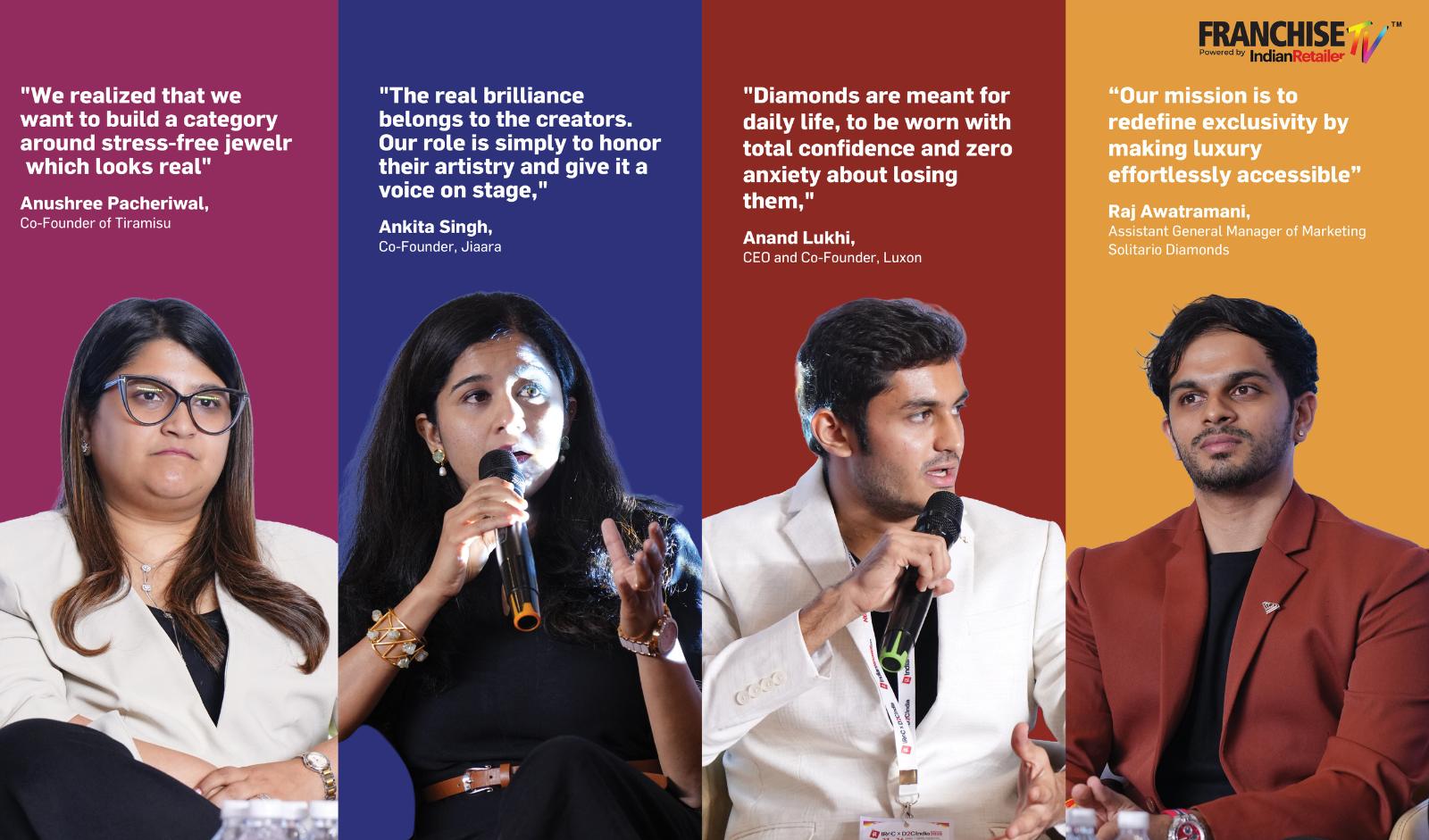
India’s $85 billion jewelry industry is shifting rapidly. Driven by rising disposable incomes, today's buyers want contemporary pieces that reflect their personal style, fit their daily lives, and don't feel out of reach. This evolution took center stage at IReC x D2C 2026 – The Big Jewelry Sparkle, where industry leaders discussed how innovation, lab-grown diamonds, and franchise retail are opening fresh doors for emerging brands to scale.
Striking a chord on this new mindset, Anushree Pacheriwal, Co-Founder of Tiramisu noted, "We realized that we want to build a category around stress-free jewelry which looks real." Ultimately, brands are moving fast to turn jewelry into an everyday expression of identity.
Diamonds Beyond Special Occasions
One of the most significant shifts in the jewelry industry is the changing role of diamonds in consumers' lives. Traditionally, diamond jewelry was viewed as a purchase reserved for weddings, anniversaries, and milestone celebrations. Today, brands are working to make diamonds a more frequent and accessible purchase.
"Diamonds are meant for daily life, to be worn with total confidence and zero anxiety about losing them," said Anand Lukhi, CEO and Co-Founder, Luxon.
This shift toward everyday luxury is helping expand the customer base for jewelry brands. Consumers, particularly younger buyers, are increasingly seeking products that fit into their daily lifestyles rather than remaining locked away for special occasions. For retailers, this means more frequent purchases and stronger customer engagement throughout the year.
As brands introduce products at more accessible price points, they are also creating a scalable retail model that can be replicated across multiple markets through franchise partnerships.
Read also: ASV Polkis Expands Through FOCO Model to Capture India’s Luxury Jewellery Opportunity
Google’s Chromebook Bets on Franchising to Scale Affordable Computing Across India
Lab Grown Diamonds Expand the Market
The growing popularity of lab-grown diamonds is further accelerating this transformation. By offering consumers a more affordable alternative, the category is helping brands attract customers who may not have previously considered purchasing diamond jewelry.
"Our mission is to redefine exclusivity by making luxury effortlessly accessible," said Raj Awatramani, Solitario Diamonds.
The category is not only creating awareness but also widening the overall consumer base. Industry players believe that lab-grown diamonds are introducing a new generation of buyers to the jewelry market. "Lab-grown technology has changed the game for diamonds," added Raj.
For franchise-led brands, this development is particularly significant. Affordable luxury products typically have broader market appeal, allowing retailers to expand into newer cities where traditional diamond jewelry may have remained a niche category. As awareness continues to grow, lab-grown diamonds are expected to play a key role in the expansion strategies of organized jewelry retailers.
Trust Becomes a Retail Differentiator
While product innovation is driving demand, trust remains one of the biggest factors influencing consumer decisions. Jewelry is a high-involvement purchase, and customers increasingly want transparency about what they are buying. "Radical transparency is something very important," said Ankita Singh, Co-founder, GIARA.
Modern consumers are no longer satisfied with simply purchasing a product. They want to understand the craftsmanship, sourcing, and story behind every piece. This has prompted many emerging brands to invest heavily in customer education and storytelling. "We tell people how their jewelry is made," added Ankita.
For franchise operators, this emphasis on transparency can be a powerful advantage. A strong brand story helps build credibility and trust, making it easier for new stores to establish relationships with customers in unfamiliar markets.
Why Product Still Drives Growth
As brands scale across different retail formats, one lesson remains consistent: the product itself ultimately determines success. Insights from airport retail offered an interesting perspective on consumer behavior. Unlike traditional shopping environments, airports often force consumers to make quick purchasing decisions.
"The most important thing that the airport taught us is that there is a lot of emotional buying while traveling," said Anushree Pacheriwal, Co-founder, Tiramisu.
In such settings, there is little time for extensive comparison or research. Customers are drawn to products that immediately resonate with them.
"Product is the king," added Pacheriwal. This principle applies equally to franchise expansion. Regardless of location, store design, or marketing strategy, sustainable growth depends on offering products that customers genuinely want to buy.
The Value of Craftsmanship in a Modern Market
While technology and innovation reshape the jewelry landscape, craftsmanship remains its beating heart. Today, forward-thinking brands are deeply investing in artisan communities, ensuring heritage techniques not only survive but drive modern retail.
"The real brilliance belongs to the creators. Our role is simply to honor their artistry and give it a voice on stage," said Ankita. Handcrafted jewelry is no longer just about preserving tradition; it has become a massive differentiator for brands trying to cut through the noise. By focusing on artisan-led storytelling, franchise partners can build actual emotional connections with local shoppers.
But the real challenge is scaling that authenticity. As Ankita, Co-founder of GIARA, puts it: "We want to make it global. We want to set up operational efficiencies here to ensure that there's a traditional art of jewelry making, but how do we set up a modern international brand which is commercially successful."
Ultimately, the goal for modern brands is finding that sweet spot balancing heritage and raw storytelling with a scalable business model that can compete on a global stage.
Read about business opportunities: 6 Consumer Brands Scaling Aggressively Across India
Top 7 Fast-Growing Street Food Franchise Brands in India
Franchising Set to Power the Next Growth Phase
The main takeaway is that the industry is changing fast. Winning now requires accessible luxury, great storytelling, and a solid mix of online and in-store shopping. For franchise investors, this is a huge win for organized brands that offer way better support and consistency than traditional shops. Ultimately, it’s not just about opening more stores; it’s about fair pricing, trust, and making jewelry that people actually want to wear every day.
At the end of the day, success comes down to what you are selling. As Anand Lukhi, CEO and Co-founder of Luxon, put it: "Product is the hero."
For Further Franchise Info Contact




Copyright © 2009 - 2026 Franchise Tv.