


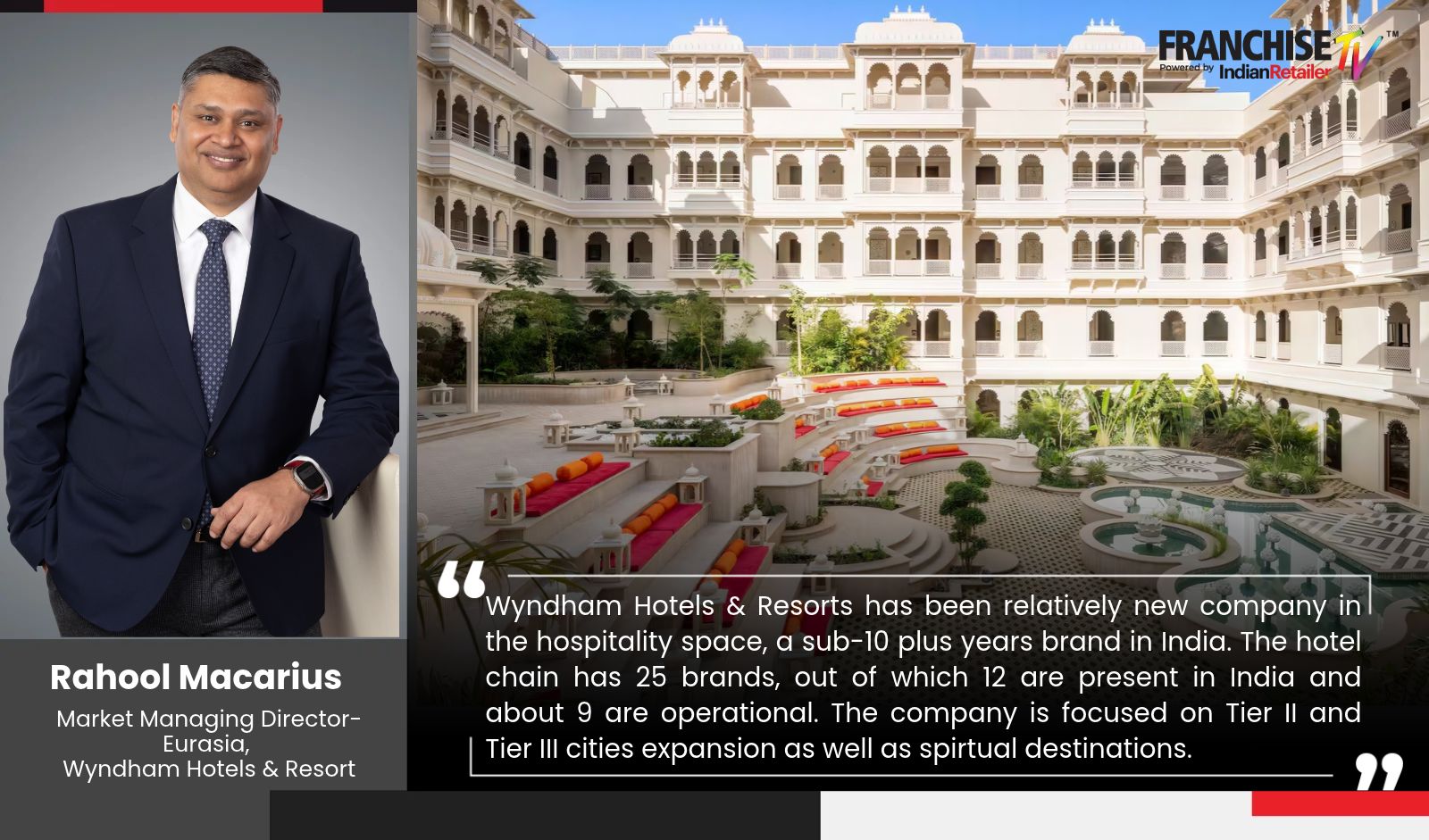
Wyndham Hotels & Resorts is one of the world’s largest hotel franchising companies having approximately 8,500 hotels and properties in approximately 100 countries. The New-Jersey based brand operates an asset-light business model focusing on hotel franchising, and operates 25 brands across the globe, ranging from economy stays to distinctive luxury experiences.
India’s Entry
The brand entered India, almost a decade ago, and rapidly expanded its footprint in the country.
Talking about the brand’s entry in India, Rahool Macarius, Market Managing Director -Eurasia, Wyndham Hotels & Resort, says, ‘‘Wyndham has been relatively a new company in the hospitality space in India. We are a sub-10 plus years brand in this part of the world. We entered India a little later than the other international brands, but we expanded rapidly. When Wyndham entered India or South West Asia, 80% of the hospitality companies were managing hotels. Wyndham was the first complete franchising company in the region.’’
The company has a footprint in India, Sri Lanka, Nepal, in this part of the world.
Brand Portfolio
Wyndham has 25 brands under its wings, out of which 12 are present in India and about 9 are operational, reveals Rahool.
Some of the brands that are under Wyndham are: Super 8, Days Inn, Ramada, La Quinta, Howard Johnson, Travelodge, AmericInn, Wyndham Garden, Baymont, Microtel, Wingate, Hawthorn Suites, Trademark Collection, TRYP, Wyndham, Esplendor, Dazzler, Vienna House, Dolce Hotels and Resorts, Wyndham Grand, Wyndham Alltra, Echo Suites, and Water Walk.
‘‘One of the reasons that we want more brands to enter the Indian market is because we feel that India is ready for those particular demands. We're not planting brands for the sake of planting a particular brand. Our whole intention is to get the right brands at the right time, in the right market to capture the right segment,’’ says Rahool.
Opportunities in Tier II and Tier III Cities
Further discussing Tier II and Tier III expansion, Rahool shares, ‘‘We are one of the strongest players in Tier II, and Tier III markets. When we entered India, most of the hotel companies were focusing on metros and Tier I cities while we focused on Tier II and Tier III cities. The kind of growth happening in these regions like the infrastructural growth, airport openings, rising disposable income, and the aspirational demands to visit these cities have created a great opportunity for us in this region.’’
Citing an example, Rahool shares that Wyndham has close to 5 hotels in Udaipur, and 5-6 hotels in Jaipur, with 2-3 more hotels in pipeline. The brand is also opening its hotels in spiritual destinations like Ayodhya and Bodhgaya, gaining a lot of traction from these places.
‘‘Everyone has to realize that Tier II and Tier III cities today are becoming Tier I cities (in terms of growth, infrastructural development and aspirational demands),’’ says Rahool. ‘‘Wyndham has become an aspirational brand in these Tier II, and Tier III cities. Hotel owners who have one or two properties with us, want to build more hotels with us. We gradually aim to cover the complete India.’’
Franchising At Play
Talking about the franchising ecosystem in India, Rahool says ‘‘Franchising is a globally accepted format; a collaboration between the brand and the owners. In this part of the world (Southwest Asia), this model has been accepted amazingly well. Most of the international brands have also now started franchising.’’
He says that what really helps franchisees is to respect the owners' knowledge about their local markets. International brands create a great distribution network, loyalty factor and technology plan, leveraging this knowledge. So the marriage between local market insights and SOPs of the brand really works out very well from a return on investment standpoint.
Domestic Demand is the Key
Rahool further shares that 85-90 % of the business in hospitality in India is domestic.
He says, “We were among the first companies that recognized that India’s hospitality sector is primarily driven by domestic demand. While the industry often focuses on distribution, we viewed it as a means of strengthening local and pan-India sales. Approximately 85–90% of the hospitality business in India is driven by domestic demand, while inbound tourism remains relatively low compared to international markets.”
Hospitality Sector in India
According to Modor Intelligence, the India hospitality market size is projected to be USD 27.96 billion in 2026, and is expected to reach USD 55.67 billion by 2031, growing at a CAGR of 14.76% from 2026 to 2031.
The sector is driven by a larger domestic travel base, a rising middle-income population, and improved air and road connectivity that increases travel frequency. Domestic visitor spending has been rising and is expected to continue, highlighting the sector’s reliance on local travelers across leisure, pilgrimage, and business segments.
Airports in India have increased over the past decade, while government programs are expanding destination and pilgrimage infrastructure, creating new investing opportunities.
Further, hospitality operators are adopting asset-light models to reduce capital risk and leveraging digital strategies to gain new customers and retain repeat customers through proprietary channels. Overall, the sector is fueled by domestic demand, improved connectivity, and strategic industry adaptation.
Discussing the sector’s growth and opportunities, Rahool shares, ‘‘I think hospitality in India is changing big time. Compared to developed international markets, India is growing at a steady rate, giving us a greater opportunity and a playing field. Hospitality invariably started with luxury in India but now there is a rise in the mid-market segment. As per JLL, 70 % of the new inventory is going to be in Tier II, and Tier III cities of India. The sector is capturing India's middle market, which is the largest market for us (Wyndham Hotels & Resorts) as well.’’
Current Trends in the Sector
‘‘Luxury is one of the predominant segments in the hospitality sector, but now it is becoming more of a personal experience for the customers,’’ says Rahool.
He further shares that temple-stays or spiritual tourism is also gaining traction in the sector. Destinations like Ayodhya, and Vrindavan have great hospitality options coming in. By-leisure staycation is also gaining popularity where people are travelling during weekdays, merging their remote work with leisure activities. A lot of travel adventures and women-solo trips are also new trends rising in India. Weddings are another great market for the hospitality industry in the country, where destination weddings contribute a major revenue pie for most of the hotel chains.
Role of Technology and Data Analytics
Technology and data integration play a significant role for better guest experience and backend operations, be it HR, finance, marketing or any other domain. Data is extremely important to streamline different operations, and to create a seamless guest experience.
‘‘If you want to get all your brands on one track, then technology is ‘the track’, says Rahool. He further says, ‘‘Technology and data analysis help us understand the kind of inventory we have, peak dates, and price regulations for better customer traction. Guest experience and revenue management are also extremely important and technology and data plays a significant role in this.’’
Future Plans
Wyndham's growth journey has been on a fast-track in the last 10 years, with close to 100 properties/ hotels already established in the country. The company aims to cross the century mark this year, and have a pipeline of hotels already in development.
Sharing about the future plans, Rahool says, ‘‘I think there is tremendous opportunity for Wyndham in India and we don’t want to give a specific number to our expansion strategy as we have the potential to surpass them and create new milestones for us. We do not want to limit ourselves to a specific number.’’
‘‘Our growth has happened in the mid-market phase. Now we are focusing on upscale brands coming into India like Wyndham Grands, the Dolce Nova, the Wyndham Gardens, Ramada, Registry Collection. These brands have been growing organically for us. For us, luxury does not mean ‘high price’, but the ‘right price’. We will not confine ourselves to the luxury or the mid-market segment, but will grow with the right opportunities that the market provides us,’’ signs off Rahool.
For Further Franchise Info Contact





Copyright © 2009 - 2026 Franchise Tv.