


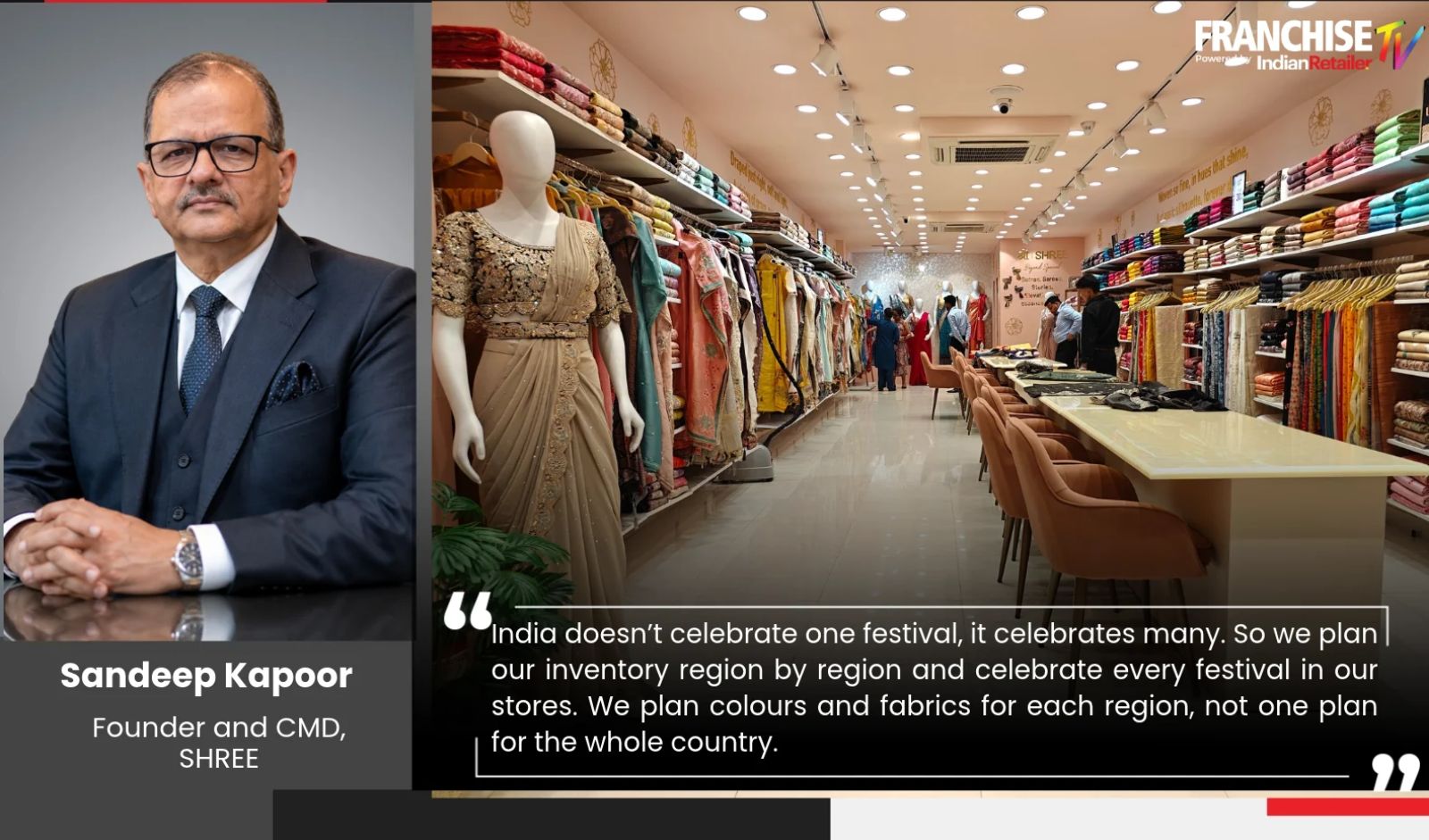
SHREE believes that ethnic wear is no longer limited to occasion but has expanded its utility beyond that to everyday use. The brand observed that every region has its own festivities, customer preferences and style that needs to be followed. A woman' s choice and expectation in ethnic wear is no longer restricted to a particular geography but throughout the globe, thanks to the growing internet penetration and smartphones. Therefore accessible touchpoints have become a necessary condition for ethnic wear brands leading to ethnic wear franchisees in India and SHREE is no exception.
SHREE’S Background
Sandeep Kapoor started his journey from Punjab. In 1987, he started selling textile and established a factory in 1988. For almost 20 years, he made clothes for different brands, mostly big retail chains in India. In 2004, he received his first ethnic wear order for a value of INR 6 crore and this form the basis of Shree’s journey in ethnic wear segment.
SHREE was founded in the year 2009 with a clear vision to provide stylish, comfortable and muti-category Indian women wear. Sandeep and his wife Sheetal opened their first store in Naraina, Delhi in 2015, right above their office and by 2016, they expanded to 10 stores
Retail Footprint
SHREE has opened 120+ stores across India and overseas, including the UAE, Saudi Arabia and Singapore. Now the brand is gradually expanding into South and East India.
Talking about the brand’s expansion, Sandeep Kapoor, Founder and CMD, Shree, said: ‘‘Asansol is our first store in West Bengal and we will open many more stores in North India. We have also opened our store in Hyderabad, Telangana and plan to open 20-25 more in the South region by 2028.’’
Product Portfolio and Pricing
SHREE’s product portfolio includes kurta sets, suit sets with dupattas, co-ords, dresses, kurtis, kurtas, tunics, bottoms and accessories. Everyday wear, office wear, festive and occasion wear, ‘Spring Summer’ and ‘Autumn Winter’ collections.
Talking about the portfolio, Sandeep says, ‘‘We also have separates, kurta, and bottoms which our customers can mix-and-match and wear in her own way. We work with Indian prints, colours and contemporary silhouettes, but whatever the occasion, the first thing we look at is comfort. He adds, ‘‘After more than three decades in clothes, I can say most people see a kurta and check its yarn. Therefore, we start from the yarn stage- how will the fabric feel, how will it fall, and its finishing. Our R&D runs at two stages: weaving and printing, and we use a fabric only after the full trial. We keep fabrics as natural as we can and the content is on the label, so the customers knows what they are wearing.’’
Sandeep says that the brand makes sure that the fabric does itch, or see-through, and the fit is right. The women customers should be able to sit, walk, work and move comfortably in it.
He says ‘‘We also have pockets in kurtas for carrying phones and keys, and we ensure that we have all sizes ranging from XS to 2XL. These are small things that we ensure while we are creating our product but they matter.’’
Pricing depends on the season and the offers running at that time. The offers come through the year and more so in festive season, which makes a lot of the Shree’s range affordable, mentions Sandeep.
Shree’s Outlook on Ethnic Wear Market
‘‘Ten to fifteen years ago, wearing a branded kurta was a big deal for an ordinary woman. Most bought from the roadside, says Sandeep. But this trend is changing fast. The ethnic wear is no longer kept for occasions only. Women wear it to work, in the kitchen, in a classroom, and even older women are picking up fusion styles now.’’
He adds, ‘‘For weddings and festivals, working women want comfort, and in Tier II and Tier III cities where good brands are still few, SHREE is pushing everyday comfort. Customers also find styles on their phones first and then go to a store to check them.Earlier most of this business was with local shops and markets. Now organised brands are reaching smaller cities, and women have more choice. A woman in a smaller city wants the same quality and choice she sees in Delhi. And that is why SHREE is opening its stores in Tier II and Tier III cities via franchising.
How Festive Season is Driving Ethnic Wear Demands?
Talking about the ethnic wear demands in the festive season , Sandeep says, ‘‘India doesn’t celebrate one festival, it celebrates many. So we plan our inventory region by region and celebrate every festival in our stores. We plan colours and fabrics for each region, not one plan for the whole country. We watch store sales closely, repeat fast-moving styles quickly and try not to dump stock where it won’t sell. Our merchandising and supply chain teams work closely, stores that are replenished on time and we can see stock across channels, so the right product reaches the right store.’’
Future of Ethnic Wear Franchisees
Lastly, Sandeep shares about ethnic wear franchisees in India. He emphasizes that franchisees that stay close to the store will do best. Just opening a branded store won’t be enough. Earlier a franchise store competed with local shops in the same market. But now the customer has more options, not limited to the geography, thanks to the smartphone. So a franchisee or a brand can't afford to get the product or service wrong.
He says ‘‘ The customer may like the design, but if her size isn’t there, they will look somewhere else. And what sells in one city may sit on the shelf in another. So a franchisee has to know her customers, not just the brand.’’
All in all, the brand has to have the right stock and training, and the owner has to pay attention, know their customers and understand what they want. This will matter even more in the coming years. A partner who knows her customers by name has an edge over any big chain, says Sandeep.
For Further Franchise Info Contact
Explore Franchise Opportunities by Industry




Copyright © 2009 - 2026 Franchise Tv.