


India's food service industry is not just limited to physical location and its expansion but has spread through every nook and corner of the nation via the cloud kitchen infrastructure that has seen a boom, especially during and post Covid phase. This effective format has soon gained traction due to its cost effective means to experiment and target new markets, rapidly expand the brand’s footprint, and reach high street and high footfall areas without much waiting.
One brand that very early understands the significance of cloud kitchen infrastructure and delivery is Rebel Foods. The brand started the Rebel Launcher Program in 2018 with its extensive cloud kitchen infrastructure, supply chain and proprietary technology. And one of the early users of this program is Naturals.
The Rebel Launcher Program brings together two complementary strengths: Naturals’ brand product proposition and Rebel Foods’ cloud kitchen network, technology and operating capabilities and has since then expanded across markets including Bengaluru, Hyderabad, Kolkata and Delhi NCR.
Naturals’ currently operates a 77-store network and is set to scale up to 100 stores, as it expands its reach through Rebel Launcher’s digital channels and into new markets.
‘‘I would say the collaboration with Naturals is an outcome of multiple things which happened at the same time. Over the course of the last decade, delivery has been a secular trend in the Indian market. It has increased from being fairly non-existent to being a substantial part of volumes of each and every restaurant. Post covid, it has become a main revenue stream. Over the course of these years, Rebel had built up an ecosystem of cloud kitchens which was spread across approximately 80- 100 cities . Our collaboration with Naturals happened organically. Rebel opened its infrastructure ecosystem to Naturals to serve its ice creams to the new geographies. Our partnership has grown since August of 2020, and over 6 years, this partnership has only grown stronger,’’ says Ankur Sharma, Co-founder, Rebel Foods
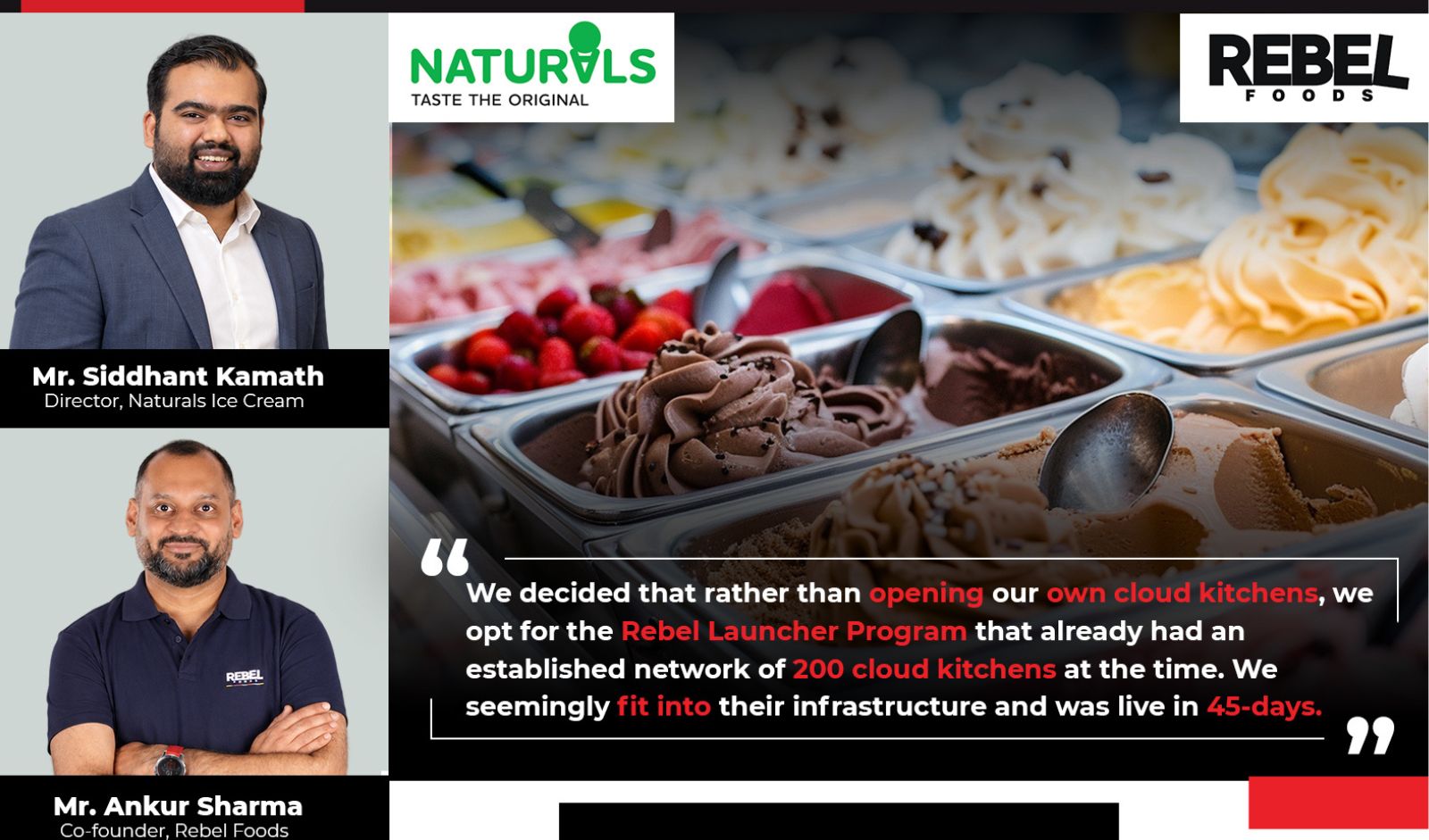
Siddhant Kamath, Director, Naturals Ice Cream, adds, ‘‘We were an offline heavy brand, with exclusive partnership format. The ice cream consumption was high at our stores, while the revenue share from the delivery was hardly 10-15 %. After Covid, hit, we were last to enter the quick commerce and food delivery market, as we were not an essential food category. We had a huge number of stores in West India but had limited presence in Delhi, Bangalore and Hyderabad, where the demand for our products was very high. We decided that rather than opening our own cloud kitchens, we opt for the Rebel Launcher Program that already had an established network of 200 cloud kitchens at the time. We seemingly fit into their infrastructure and was live in 45-days.’’
Recently the brand has expanded its footprint in Chennai via the Rebel Launcher Program. The brand primarily opens an offline store in the area and meets the demands of the different region and neighbourhood via this program.
The Rebel Launcher Program: How the Journey Started?
‘‘While we were building our program, we had to build everything from scratch,’’ says Ankur. ‘‘Whether it is was a network of cloud kitchen infrastructure, or direct integration with Swiggy or Zomato, or ensuring a supply chain to reach multiple cities or to create a consistent product and taste profile, or to churn multiple orders from the same kitchen, we learnt and created everything on our own.’’
He shares that the brand basically created an infrastructure which can enable almost any brand to enter our ecosystem and seamlessly expand with us.
Ankur reveals, ‘‘While we were creating an integrated platform for ourselves, we ended up creating a platform that anybody can leverage and expand. If any partner of ours wants to use our supply chain to send material from point A to point B, then they need not discover any new format. They can simply ‘piggy bank’ on our existing infrastructure and technology, rather than looking for different service providers in the market. So the whole idea is that whatever we have created for ourselves, can be offered to other partners in the industry and then those partners can have access to consumers in multiple zip codes.’’
Rebel Foods currently has 32 partner brands which are operating under the ecosystem. From indigenous legacy brands like Naturals and Anand Sweets, the program also has international partners like Papa Johns and Taco Bell.
‘‘Naturals is one of our early partners and holds a very special place in our heart. We want them to go to each and every corner of the country and also grow internationally. We are present in the UAE market. So in case Naturals wants to go international, we would love to partner with them internationally as well,’’ says Ankur.
Naturals’ Focus on Reach and Customer Experience
While talking about the Naturals reach in India, Siddhant says, ‘‘There is a mental block for consumers to order ice creams. But thanks to the quick commerce and now e-commerce of the world, there is now a better consumption story. He adds, ‘‘Our ice cream has a shelf life of 15-days, and I have to plan my inventory and volumes accordingly. So a lot of innovation goes into availability and supply chain management, ensuring our reach is not compromised.’’
He further shares that ice cream requires a particular supply chain temperature and SOPs during delivery, so that the product reaches the customers at appropriate condition, and they could have great delivery experience.
How Does Rebel Launcher Program Aids Different Brands
Explaining how the different brand leverages the Rebel Launcher program, Ankur shares that there are legacy brands like Naturals that already have an established customer base and the product-to-market fit. So, deeper market penetration for such brands is not difficult. But then there are new and emerging brands that may be doing well in a particular city or region but would choose a low cost experiment when expanding to new markets. This is where the Rebel Launcher program comes in. With this program, the new and emerging brands do not have to place themselves at high street locations but can use the existing Rebel Launcher Program’s cloud kitchen and distribution infrastructure to experiment their presence in new markets.
‘‘So just imagine if a brand has invested INR 50 lakhs for new store expansion, it can reduce to INR INR 6-7 lakh using our cloud kitchen,’’ says Ankur.
He further shares that the time taken to invest in new markets is also less as the brand does not have to wait for high street location availability and can rather start their operations using existing infrastructure.
Citing an example, Ankur says, ‘‘Papa Johns re-entered the Indian market last year, in October 2025. The brand opened its outlet in four or five locations.Then they wanted to start their delivery model, and therefore leverage our infrastructure, and cloud kitchens under the Rebel Launcher Program. They now operate with us and expanded themselves to new markets like Bangalore.’’
Cloud Kitchens and Food Delivery Market in India
Further talking about the role of cloud kitchens in India, Siddhant shares, ‘‘ I see great demand for cloud kitchens coming in.’’
According to IMARC, The India cloud kitchen market size increased from USD 1.24 Billion in 2025 to USD 1.39 Billion in 2026 and is projected to reach USD 3.69 Billion by 2034, growing at a CAGR of 12.28% during 2026-2034. The market is driven by rapid growth in online food delivery platforms, rising urbanization, increasing smartphone and internet penetration, changing consumer dining preferences, and growing demand for convenient and affordable food ordering services. Independent cloud kitchens dominate at 60.8% of the food and beverage sector.
He shares that cloud kitchens play a prominent role in areas that have high footfall but do not have enough space to open an outlet, meeting the high demands of the region.
Sharing his own brand’s example, Siddhant says, ‘‘Howrah Junction in West Bengal is a high footfall area and has huge demands for Naturals’ ice cream but the place lacks the potential of repeated customers, therefore such locations are better served via Rebel’s cloud kitchen that is near the Junction, than to open a store at the location presently. Moreover, Swiggy and Zomato’s integration with the IRCTC can serve the train passengers as well. So, cloud kitchens are best format to test the water or penetrate into new markets, rather than high investments on stores.’’
Ankur further shares that the Indian market is still nascent as far as the food safety standards are concerned in food and beverage establishments, be it cloud kitchens, restaurants, kiosks and express counters and other formats. However, Rebel Foods D2C platform EatSure provides a full-stack control from food prepared at its outlet or cloud kitchen to customer delivery
‘‘As I crystal gaze into the future, we believe convenience will remain a very important aspect for customers, and the cloud kitchen and food delivery market will continue to grow in the country. It has helped us create a multi-brand portfolio and operate these brands through a single infrastructure. However there are some general misapprehensions about the quality and food safety standards in such infrastructure. This is where our brand stands out from the rest of the competitors as we ensure utmost quality and the food safety standards at our cloud kitchens and outlets, ‘’ shares Ankur.
Cloud kitchen and delivery experience in India has overall improved but there is a lot of work which still needs to be done, says Siddhant.
Roadmap for the Future
Talking about the future plans for Naturals, Siddhant shares, The next 5-10 years will be super super exciting as India's consumption story is becoming strong. There are about 200 Naturals stores in India and close to 75 cloud kitchens in partnership with Rebel. We are looking to double our stores from 200 to 400 and our cloud kitchens to 300 in the next three years. In the next 10 years, we are looking at international expansion, and will probably collaborate with the Rebel Launcher Program to expand overseas.’’ He adds, ‘‘India is on the rise. So I will see tremendous opportunity in the foodservice and food delivery sector with new partners coming in this space. I think in the next five years will develop a food commerce ecosystem where we are rooting for Rebel to be market leaders.’’
Ankur shares that Rebel Foods in India is really starting to surface. ''We are already present in 450 locations in India. can easily become 1000 by the end of next 24 to 36 months. We believe that this is just the beginning of our journey. With the number of brands which are coming into the Indian market, Indian customers are not only becoming adventurous in consuming domestic products, but also looking to explore other regional and exotic cuisines. So these are really exciting times for the F&B market in India,'' signs off Ankur.
For Further Franchise Info Contact
Explore Franchise Opportunities by Industry




Copyright © 2009 - 2026 Franchise Tv.