





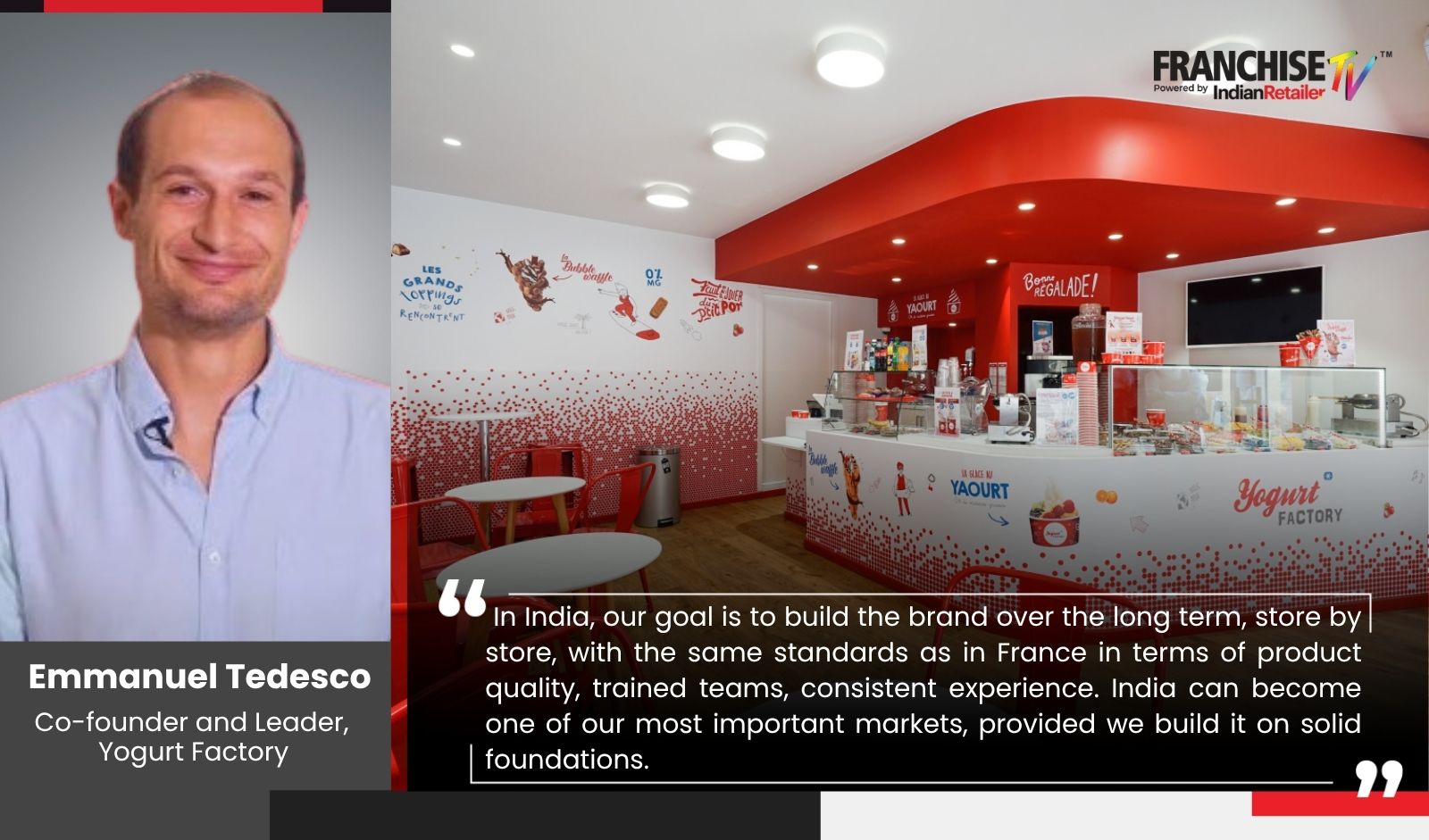
Yogurt Factory is France-based prominent frozen yogurt franchise brand, known for its ‘gourmet frozen yogurt’ concept that is rapidly expanding across the globe.
‘‘Yogurt Factory was founded in Paris in 2012 by Ouriel Hodara and me, two HEC Paris graduates who wanted to bring a fresh, playful approach to frozen dessert.’’ says Emmanuel Tedesco, Co-founder and Leader of Yogurt Factory.
The brand offers 0% fat frozen yogurt served with a wide choice of toppings such as fresh fruit, cereals, cookies, sauces and so on, so that every customer can build their own cup.
Brand’s History and Retail Footprint
The brand started its journey with its first store launch in Paris in 2012. Today, the brand operates around 90 units, combining company-owned stores and franchises.
‘‘We started our franchise activity in 2016. We acquired our competitor Boon in 2018 to consolidate our leadership; and passed 50 points of sale in 2021,’’ reveals Emmanuel.
Over the years, the brand has extended the menu with a wide range of beverages-smoothies, milkshakes, bubble teas - and waffles – bubble waffle and waffle from Liege. In 2026, the brand ran its first national TV campaign in France. Internationally, the brand is present in 10 countries - Belgium, Luxemburg, Spain, Senegal, Gabon, Uzbekistan, Malaysia, New Caledonia - and finally entered India in 2016 with FranGlobal.
Entry into the Indian Market
Talking about the brand’s entry in India, Emmanuel shares, ‘‘India is our most recent market, which we are about to enter through a master-franchise agreement. We see it as a long-term market: our priority is not the number of openings but making sure that every store meets our standards before it opens and delivers the complete Yogurt Factory experience – our product, our recipes, our trained teams. Growth will follow that standard, not the other way around.’’
Franchising in Yogurt Factory
Franchising allows Yogurt Factory to scale from Paris to a national network. It combines the brand’s know-how such as concept, recipes, supply chain, marketing, training – with the commitment of local entrepreneurs who know their catchment area and are personally invested in the success of their store.
Further discussing the franchise concept, Emmanuel says, ‘‘We deliberately keep a mix of company-owned stores and franchises. Our own stores are our laboratory where we test new products, formats and processes there before rolling them out to the network. Franchising then gives us speed and geographic reach with a lighter capital requirement.’’
Internationally, the brand relies on master franchising, which gives its local partner the capacity to develop an entire territory.
‘‘It works when the partner shares our standards and our long-term vision. Choosing the right partner is by far the most important decision in international franchising,’’ says Emmanuel.
Franchising Ecosystem in India
‘‘India is one of the most dynamic franchising markets in the world. There is a strong appetite for international brands, a growing base of entrepreneurs and investors, and a rapid development of organised retail – malls, airports and high streets in tier-1 and, increasingly, tier-2 cities. The ecosystem is also becoming more professional, with more structured contracts and more demanding operators,’’ says Emmanuel
He further shares his experience explaining how a business can become franchise-ready. He emphasized on the four conditions: Proven unit economics, over several years and several locations, including company-owned stores. Codified know-how: operations manual, recipes, training programme. A reliable supply chain that guarantees consistent product quality everywhere. And lastly, A franchisor organisation able to support, train and control its network.
‘‘For international expansion, I would add a fifth: the ability to protect the brand’s standards through a solid contractual framework and a genuine partnership with the master franchisee,’’ says Emmanuel.
How Operational Support, Training and Communication Leads Franchise Success
Yogurt Factory’s new franchisee follows 2 weeks of training in France, including hands-on time in its stores, covering product preparation, hygiene and food safety, customer service, store management and local marketing. The team is present on site for the opening, and field coordinators, followed by regular visits and performance reviews.
‘‘Operational support, training and ongoing communication are absolutely essential for franchise success,’’ says Emmanuel. He adds, ‘‘In our model, no store opens without its team being fully trained. Consistency is what builds a brand: a customer must have exactly the same experience whether they are in France or abroad.’’
He further shares that ongoing communication is also an essential pillar. Through the brand’s internal platform, franchisees access e-learning modules, operational updates, marketing campaigns and product launches, and the brand can exchange its ideas and strategies with the rest of the network.
Role of Technology and Data Analytics
Further sharing about its technology-in-use, Emmanuel says ‘‘At Yogurt Factory, technology is at the heart of how we manage the network. We have built our own internal platform, Cerca, which centralises data from our point-of-sale, delivery and loyalty tools. It gives us a clear view of each store’s performance – sales, average ticket, product mix, trends – and allows us to benchmark stores, detect early warning signs and focus our support where it matters most.’’
Cerca is also our project-management and training tool. It tracks every new opening step by step and hosts the e-learning content. On the customer side, the stores are connected to the main delivery platforms through a single integration. Further, the loyalty programme helps the brand to understand the purchasing habits and personalise offers.
‘‘Data also drives product innovation: our limited editions and new launches are decided by looking at what customers actually buy, and at what they tell us on social media,’’ says Emmanuel.
Yogurt Factory’s Outlook on Indian Ice Cream and Frozen Dessert Market
Emmanuel further shares his insights about the Indian ice cream and frozen dessert market. He says, ‘‘The Indian ice cream and frozen dessert market is large and still growing fast. It remains dominated by traditional ice cream, but the premium and “better-for-you” segments are growing faster than the market as a whole.’’
The drivers for the segment are the country’s young, urban population; rising disposable incomes; the expansion of malls and modern retail; the growth of food delivery; and a much stronger awareness of health and nutrition.
‘‘Social media also plays a major role in the segment expansion, as dessert has become an experience you share,’’ says Emmanuel. ‘‘This is exactly where frozen yogurt fits: an indulgent treat that feels lighter, with endless personalisation. The category is still young in India, which is both a challenge – customers need to discover it – and a significant opportunity.’’
New Market Trends and Customer Preferences
There are several trends that are clearly shaping the segment. Some of them are:
Mindful indulgence: Customers want pleasure, but with lighter and cleaner options – less fat, less sugar, natural ingredients, real fruit.
Personalisation: People want to create their own dessert, which is the very essence of our concept.
Experience: Dessert is a social moment, so design, colours and visual appeal matter.
Newness: Customers expect frequent limited editions, so we regularly launch seasonal toppings, some of them voted for by our community.
Hybrid products and new formats: Frozen desserts are blending with bakery, drinks and snacking[ – we are currently working on a frozen yogurt brioche concept], and they are moving into new locations such as travel hubs and kiosks.
Delivery: A growing share of sales, which requires products designed to travel well.
Road Ahead
Yogurt Factory’s ambition for the next five to ten years is to become the international reference brand in frozen yogurt. The brand will not just densify its network in France but also selectively expand to the Middle East and Asia. In India, the brand will build itself store-by–store, creating an identical experience for Indian customers as in France.
‘‘In France, we will keep densifying our network, adding new formats – kiosks, travel retail, compact stores – alongside our traditional stores, and we will keep innovating on the menu. Internationally, we are focusing on a limited number of priority markets, notably Middle East and Asia, where demand for premium and healthier desserts is strong. Our approach is selective: we would rather enter fewer countries with the right partners than many with the wrong ones. In India, our goal is to build the brand over the long term, store by store, with the same standards as in France – product quality, trained teams, consistent experience. India can become one of our most important markets, provided we build it on solid foundations,’’ signs off Emmanuel.
For Further Franchise Info Contact




Copyright © 2009 - 2026 Franchise Tv.